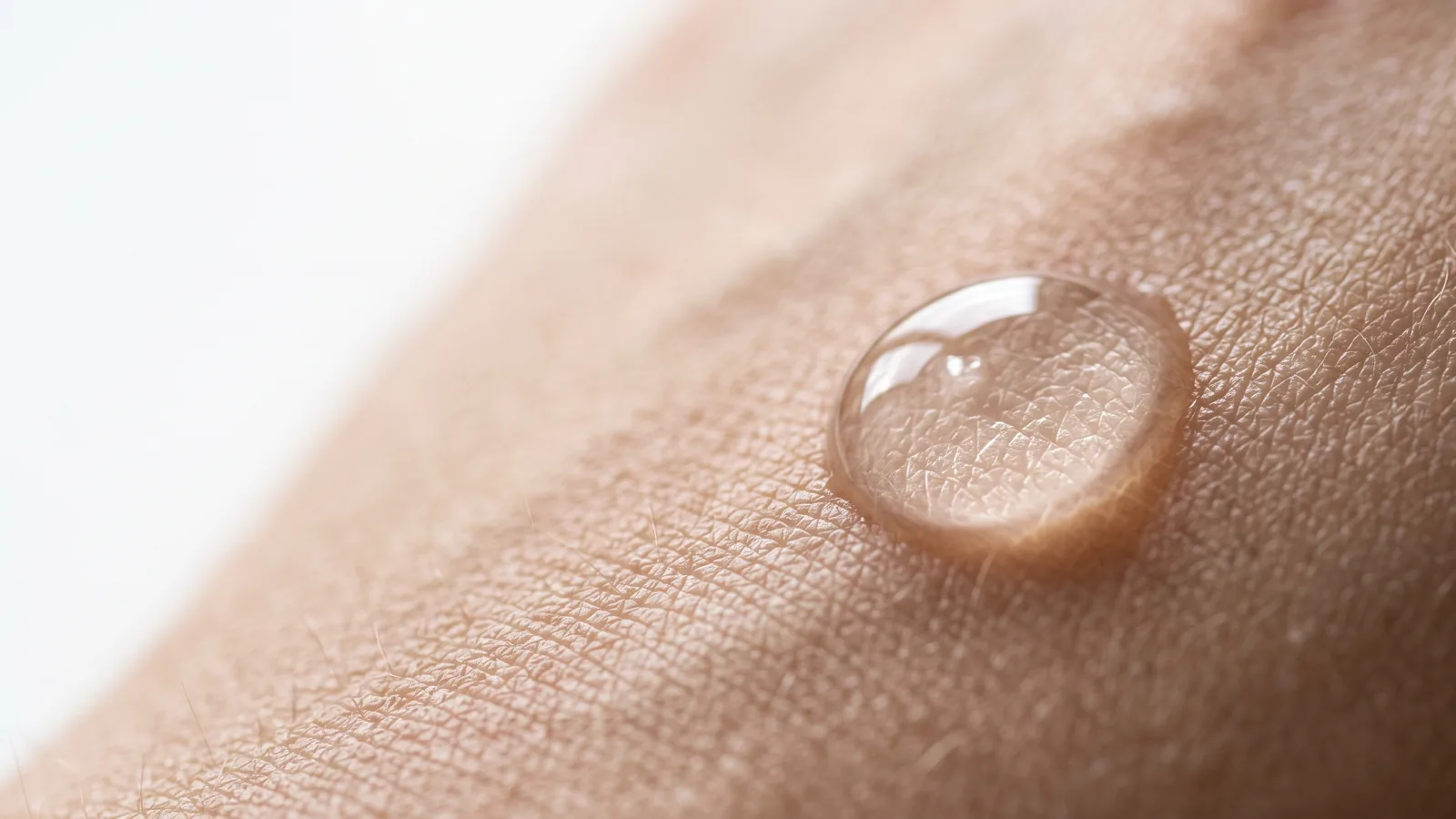
When your skin stings after applying a serum, it is not simply sensitive. It is already in defensive mode — and you have been unknowingly making it worse every single day.
There is a particular kind of helplessness in having skin that stings. You read every ingredient list. You buy the "sensitive skin" options. You go fragrance-free, alcohol-free, everything-free. And still, after applying something as minimal as a toner, that familiar burning sensation blooms across your cheeks like a quiet accusation.
The beauty industry has an answer ready: your skin is just sensitive. Try this calming serum. Add this barrier cream. And maybe — if you're lucky — you'll find the one product that finally makes it stop.
But the stinging is not the problem. The stinging is the symptom. The problem is structural, biological, and almost entirely fixable. Here is what is actually happening inside your stratum corneum.
What your skin barrier actually does
Your skin barrier — the stratum corneum — is not a static wall. It is a living, dynamic architectural matrix: 15 to 20 layers of dead cells (corneocytes) embedded in a lipid matrix of ceramides, free fatty acids, and cholesterol. Its primary job is transepidermal water retention and pathogen exclusion. When it works, you barely notice your skin at all.
When it doesn't work, you notice everything.
"A compromised barrier cannot distinguish between a vitamin C serum and a threat. To your skin, both are the enemy."
A healthy barrier maintains a pH of between 4.5 and 5.5 — slightly acidic, which is optimal for the enzymatic reactions that hold the stratum corneum together and hostile to most pathogenic bacteria. The moment that pH shifts — whether from alkaline cleansers, over-exfoliation, or even tap water — those enzymes stop working, the lipid matrix begins to degrade, and water escapes freely. This is transepidermal water loss (TEWL), and it's the underlying mechanism behind most "sensitive skin" complaints.
The vicious cycle you're stuck in
Here is the pattern that most "sensitive" skin people are living inside, without realising it:
- Skin feels tight or dull. You reach for an active — a retinol, a Vitamin C, an AHA — to brighten it.
- The active works chemically, but the barrier can't handle the disruption. Stinging begins within minutes.
- You add a calming product. The calming product, however, contains fragrance, alcohol, or synthetic emulsifiers that your compromised barrier cannot filter.
- Inflammation increases. You interpret this as a reaction to the active, not the calming product.
- You abandon the active. The skin settles briefly. The dullness returns. You restart the cycle.
What nobody tells you is that a compromised barrier cannot tolerate actives — not because actives are bad, but because the lipid matrix that normally regulates penetration is no longer functioning. Without it, actives penetrate too deep, too fast, triggering a disproportionate inflammatory response.
The Skin State vs. Skin Trait distinction
Your skin type is largely genetic. If you have Fitzpatrick Type II skin, you will always have Fitzpatrick Type II skin. If your sebaceous glands produce excess sebum, that tendency does not disappear.
Your skin state, however, is situational. It reflects the current condition of your barrier — and it can change dramatically in either direction depending on what you're exposing it to. The chronic confusion between state and trait is the root cause of most ineffective routines.
"You cannot fix a temporary state with a permanent product strategy. You fix a state with a protocol designed for it."
If your skin is currently in a reactive, barrier-compromised state, no amount of the right products will help — because your barrier cannot even receive them correctly. The penetration depth is wrong. The enzymatic environment is wrong. The pH is wrong. You need to reset the state before introducing any intervention.
The Barrier First Framework
The 28-Day S.O.S Protocol is built on a single, evidence-informed principle: you cannot add value to a broken system. You must first restore the system.
Phase 1 — the Audit — maps every product in your current routine against barrier compatibility criteria: pH level, surfactant class, emulsifier type, active concentration, and fragrance load. This is not intuitive. Many products marketed as "barrier-supporting" or "sensitive skin approved" contain ingredients that actively degrade the lipid matrix.
Phase 2 — the Fast — reduces your routine to its irreducible minimum: a pH-balanced cleanser, a ceramide-dominant moisturiser, and SPF. No acids. No retinoids. No vitamin C. No exceptions for 28 days. The goal is to allow the enzymes responsible for lipid lamellar formation to function undisturbed by chemical interference.
Phase 3 — the Reintroduction — is where actives come back. Slowly. Strategically. With a clear protocol for identifying tolerance and a method for distinguishing purging from genuine reactivity.
The reason the protocol is 28 days is not arbitrary. The average skin cell turnover cycle in adults is 28 to 30 days. Meaningful barrier recovery requires at minimum one full cycle. Claims of "barrier repair in 7 days" are marketing, not biology.
What to expect during the 28 days
Week 1 — Stabilization. Uncomfortable for most people. The skin is accustomed to stimulation — acids resurfacing, retinoids accelerating turnover, actives doing visible work. Without them, the surface may look temporarily duller and feel different in texture. This is not regression. It is baseline. The panic response stops and inflammation begins to fall.
Week 2 — Repair begins. Most people notice a significant reduction in reactivity. The burning sensation after cleansing decreases. The skin is producing new lipids, so it holds moisture for longer. Tightness eases and redness may begin to resolve.
Week 3 — Strengthening. This is when the feedback loop changes. The skin begins to feel genuinely calm — not the artificial calm of a sedating formula, but structural calm. The barrier is visibly stronger and doing its job again.
Week 4 — Mastery. Calibration. Full epidermal renewal is complete and you are looking at a fresh, un-irritated layer. You are now ready to understand your skin as it actually is — not as it behaves under chronic stress. This is the state you design your long-term routine for.
The informed operator vs. the anxious consumer
The goal of the S.O.S Protocol is not just a calmer complexion. It is a different relationship with your skin — one based on understanding rather than reaction.
An informed operator knows why she is using each product, at what stage, in what concentration, for what outcome. She can identify what is happening during her cycle and adjust accordingly. She is not surprised by purging. She knows when to wait and when to stop.
An anxious consumer is controlled by her skin. Every change triggers a product change. Every instagram ingredient prompts an experiment. The routine expands because problems multiply — each solution creating the conditions for the next problem.
"You are not at the mercy of your skin. You are its operator. The 28 days gives you the manual."
The transition from one to the other does not require expensive products or professional interventions. It requires understanding the biology — and the discipline to apply it consistently for 28 days.